The Fed Doesn't Create Volatility—It Reveals It
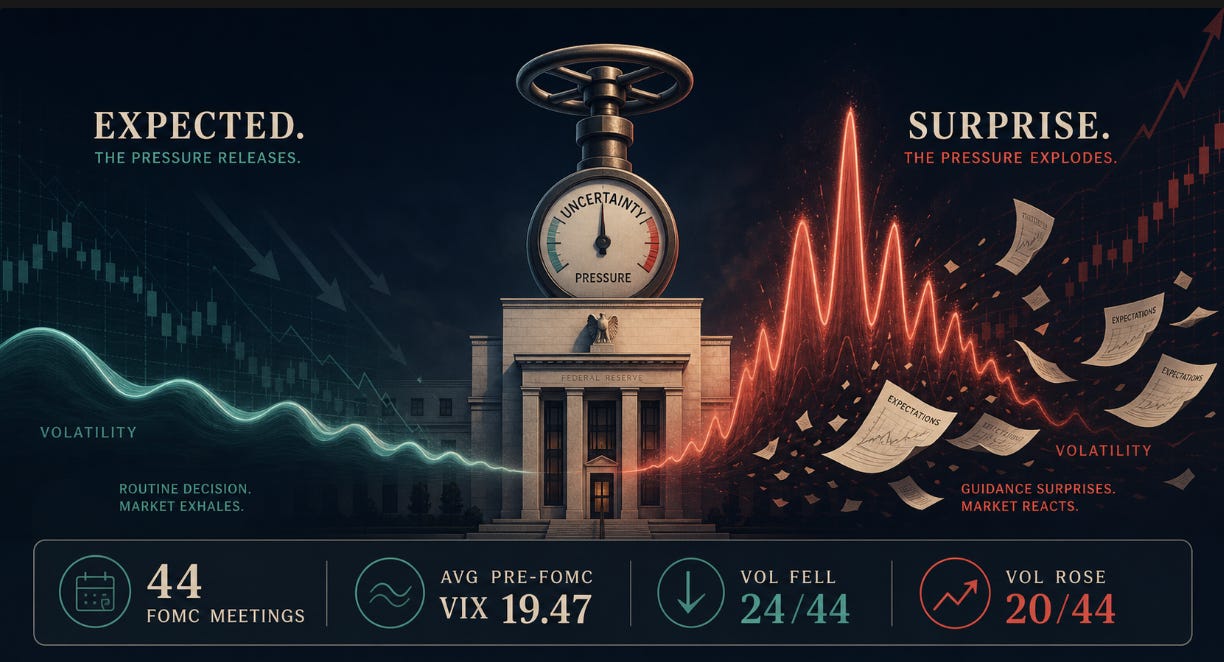
"The market doesn't care what the Fed does. It cares whether the Fed surprises it."

Every FOMC meeting comes wrapped in the same prediction:
“Volatility is about to explode!”
Sometimes it does.
Most of the time?
It doesn’t.
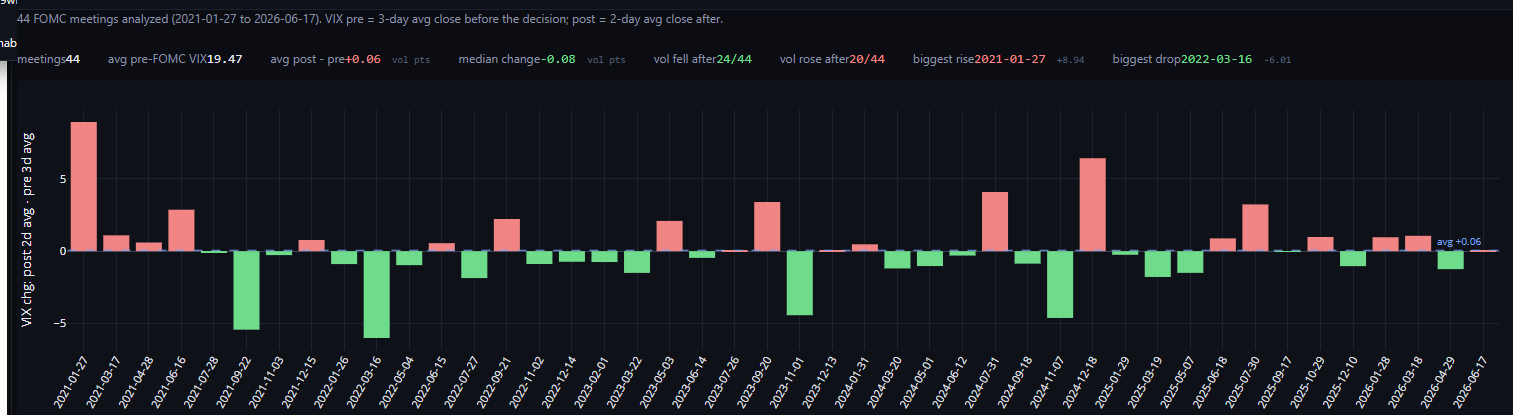
I recently looked at the VIX immediately before and after the last 40 FOMC decisions, expecting to find a reliable pattern.
Instead, I found something much more interestin
g
.
The Average Lies
Across the last 40 meetings:
• Average VIX change: -0.27 points
• Standard deviation: 2.34 points
• About 60% of meetings saw volatility fall after the announcement.
At first glance, you might conclude:
“Great! Sell volatility before every Fed meeting.”
Not so fast.
A standard deviation nearly nine times larger than the average tells us the “edge” is tiny compared with the variation. In other words, the average outcome tells you very little about what will happen at the next meeting.
Markets don’t trade averages.
They trade surprises.
The Two Meetings That Tell the Story
Consider the extremes.
December 18, 2024
The Fed cut rates.
Sounds bullish.
Except it wasn’t.
Chair Powell signaled far fewer rate cuts ahead than Wall Street expected. The market got blindsided, and the VIX exploded 43.5% in a single day.
The surprise—not the cut—created volatility.
Now compare that with:
March 16, 2022
The Fed delivered the first rate hike of the cycle.
Everyone knew it was coming.
The uncertainty disappeared.
The VIX fell nearly 20% immediately afterward.
Same event.
Completely different reaction.
The Real Edge
The market spends days pricing in uncertainty before an FOMC meeting.
When the announcement simply confirms expectations, uncertainty disappears.
Volatility usually shrinks.
When the Fed changes the narrative, uncertainty actually increases.
That’s when volatility expands.
The meeting itself isn’t the catalyst.
The surprise is.
What This Means for Traders
Rather than asking:
“Will the Fed raise or cut?”
Ask:
“How different is today’s message from what traders already expect?”
That’s the question that matters.
Possible Trading Ideas
These aren’t mechanical systems—they’re frameworks worth testing.
1. The Volatility Fade
When the market has spent several sessions bidding up implied volatility and expectations appear well aligned with the consensus, consider looking for opportunities to benefit from post-announcement volatility compression.
Examples include:
• Iron condors
• Credit spreads
• Short premium positions with defined risk
The key is avoiding meetings where expectations appear fragile or highly divided.
2. Wait for Warsh
Many of the biggest moves don’t occur at 2:00 PM when the statement is released.
They occur during the press conference.
Often the first move gets completely reversed as traders digest Warsh’s answers.
Patience can be a profitable strategy.
3. Trade the Surprise—Not the Decision
A rate cut isn’t automatically bullish.
A hike isn’t automatically bearish.
Markets compare reality with expectations.
That’s why a “hawkish cut” can send stocks lower while a well-telegraphed rate hike can trigger a rally.
4. Let Volatility Come to You
I’ve found that chasing the first fifteen minutes after an FOMC announcement is usually an expensive hobby.
The better opportunities often appear after the emotional reaction settles and institutions begin repositioning.
The Bottom Line
The Fed doesn’t create volatility.
It reveals whether the market understood the assignment.
If everyone already agrees with the Fed, volatility usually leaks away.
If the Fed changes the story, volatility can explode.
That’s why the average VIX change after FOMC meetings is almost irrelevant.
The tails are where the money—and the lessons—live.
As traders, our job isn’t to predict the decision.
It’s to recognize when the market’s expectations and the Fed’s message are about to collide.
That’s where the real edge begins.