IBM covered call strategy

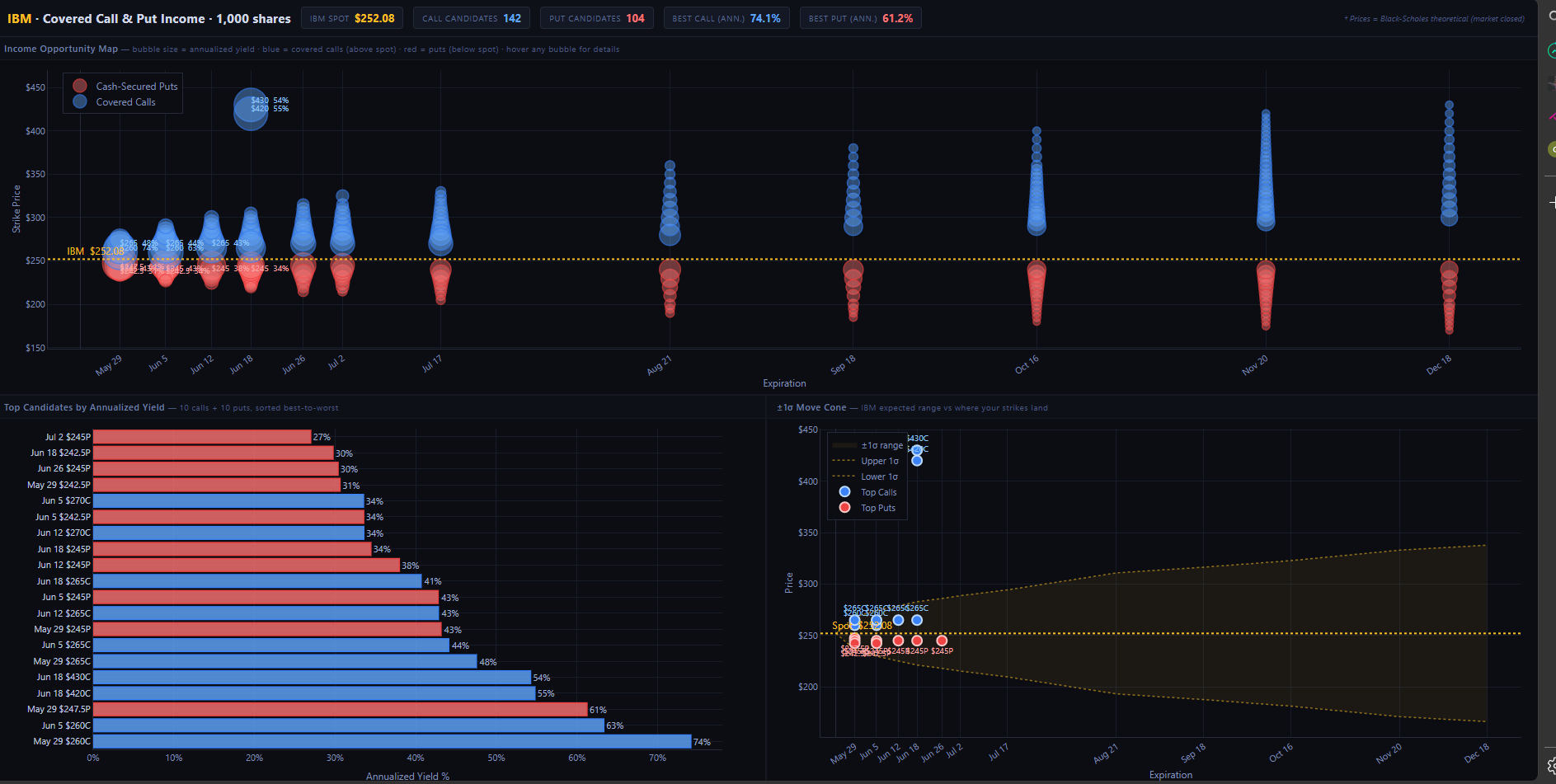
Title: How to Get Paid to Be Patient with IBM: A Covered-Call + Cash-Secured-Put Play
If you own 1,000 shares of IBM and your goal is “squeeze income while dodging the big gotchas,” you don’t need wizardry—you need structure. Here’s a clean, rules-based plan built from the data above, plus how to manage it without turning your weekends into a Bloomberg cosplay.
The setup: paid patience
Core view: IBM at ~$252 is a slow, dividend-laden cruiser with one unruly passenger: upside rumors. Implied volatility is quirky—calls are pricier than puts, an inversion that pays covered-call sellers.
Position size: 1,000 shares. We’ll add a put overlay only if you’re comfortable owning another 1,000 on a dip.
Two-leg menu, choose one or both.
Income backbone: Sell 10x Jul 17 $280 covered calls
Why this strike/date
$280 is ~11% above spot. That’s a decent runway in 55 days.
Delta ≈ 0.30, so roughly 70% odds of expiring worthless.
Most liquid call in the chain (tight spreads = easier to enter/exit/roll).
Premium ≈ $7,730 on 10 contracts ≈
3% of a $252k stock stake over 55 days (20% annualized if repeated).Skew edge: IBM’s calls run 44–50% IV vs 35–41% on puts—unusual and favorable for call sellers.
What this leg does for you
You monetize time and the rumor premium while giving IBM room to drift upward.
If IBM finishes ≤ $280 on Jul 17, you keep shares + all premium. If it finishes > $280, you’ll manage (see Playbook below).
Optional booster: Sell 10x Jun 18 $240 cash‑secured puts
Do this only if you’re willing to own another 1,000 shares at a net of about $235.54 ($240 strike minus ~4.46 premium).
Why $240
~5% below spot, delta ≈ −0.29 (about 71% odds to expire worthless).
Most liquid put in the chain.
Adds ≈ $4,460 in 26 days (~25% annualized).
What this leg does for you
You’re paid to post a limit buy at a discount. If IBM stays above $240 through Jun 18, you pocket the cash and move on with the covered call still working.
Combined picture (if you run both)
Premium intake ≈ $12,190 before assignment or rolls.
“Assignment requires” scenarios:
Calls: IBM rallies > ~11% to tag $280 by Jul 17.
Puts: IBM drops > ~5% to tag $240 by Jun 18.
The management playbook: simple rules, no heroics
Think three states: Up, Sideways, Down. Decide once; react mechanically.
A) IBM rips higher fast (the one risk you must watch)
What it means: The market’s call IV told you this could happen—M&A chatter, a surprise catalyst, or AI headlines.
If price approaches or clears $280 well before Jul 17:
Roll “up and out” for a net credit if available.
Example mindset: Roll Jul $280 → Sep $290 (or nearest liquid higher strike) for a credit. You raise your ceiling, buy time, and keep the cash flow flowing.
If credits vanish (rare with this skew), accept assignment at $280 only if the post‑tax outcome and your target price say “fine.” Remember, you captured gains from $252 → $280 plus premium—hardly a tragedy.
What not to do: Don’t panic-buy the call back on a spike. Let IV work for you—look for rolls when spreads are tight and credit exists.
B) IBM meanders (the base case)
Calls decay, puts (if sold) likely expire. Do nothing. Let theta make your coffee.
On Jun 18:
If $240 puts expire worthless: close them, bank the premium, and—if you still want booster income—sell the next set with ~3–5 weeks to go and a strike ~5–7% below then-spot.
On Jul 17:
If $280 calls expire worthless: rinse and repeat. Pick a new strike ~8–12% above spot with top-of-chain liquidity and a 0.25–0.35 delta.
C) IBM dips (orderly, not a faceplant)
If you sold the $240 puts and IBM finishes below $240 on Jun 18:
You’re assigned another 1,000 shares at an effective ~$235.54.
Immediately sell covered calls against the new shares as well—same 0.25–0.35 delta framework, preferably above your blended cost.
If only the stock (no puts) drifts down:
Keep the Jul $280 calls. Their decay accelerates as price falls—good for you. Reassess strike on expiry.
D) IBM tumbles (severe selloff)
With cash‑secured puts:
If pre‑expiration losses worry you, convert to a wheel-friendly roll: roll the $240 puts down and out (e.g., to a later expiration one or two strikes lower) for a net credit, keeping assignment price aligned with your comfort zone.
With shares + calls:
Calls cushion the drawdown; do nothing until closer to expiry, then reset strikes that remain comfortably out of the money.
Greeks-in-plain-English checkpoints
Delta (≈ 0.30 on the $280C, −0.29 on the $240P): tells you “about one‑third odds of finishing in the money.” Useful sanity check.
Theta: both legs earn from time passing. Sideways is your friend.
Vega: spikes help your rolls. If headlines pump IV, look to roll the call for fatter credits.
Risk table, decoded like a human
Assignment risk on calls isn’t failure; it’s capped upside. Your remedy is rolling for credit. You still own price appreciation up to the prior strike plus all collected premiums.
Assignment risk on puts equals “Do I want more IBM at a discount?” If yes, it’s not risk—it’s plan A.
Liquidity matters more than cleverness. Tight spreads and big open interest keep your exits cheap and your nerves unfrayed.
A tidy weekly routine
Monday: 30‑second check—are we near $280? Any credible catalyst scheduled? If yes, pre-plan a roll level.
Wednesday/Thursday: Peek at roll quotes. If you can move “up and out” for a net credit of at least 0.30–0.50% of notional per month, take it.
Friday close, two weeks before expiry: If calls remain >10% out of the money and premium has mostly bled out, consider buying-to-close cheaply and immediately re‑selling a fresh cycle to keep cash compounding.
What could go wrong, realistically
A sudden takeout at a fat premium. You’ll likely be called away. That outcome usually beats your base-case IRR; just don’t chase it back in the next day.
A gap down through $240 before puts expiry. You’ll be long more shares than planned—mitigate by pre‑committing to the wheel (calls out the door immediately) and by sizing cash so this never becomes a forced sale.
Why this works specifically for IBM right now
The call/put IV inversion is paying you to sell the upside fear. That’s rare. When calls are the expensive side, covered calls are the right hammer.
The $280C and $240P sit at the top of the liquidity stack—cheap to trade, easy to roll.
The distance to each strike aligns with sensible probabilities: about 70% chance each leg expires without drama, yet the combined premium is meaningful.
Bottom line
Cleanest single trade: 10x Jul 17 $280 covered calls. It expresses “get paid while I wait” with low maintenance and a built‑in edge from IBM’s skew.
Optional booster for the wheel-inclined: 10x Jun 18 $240 cash‑secured puts. You’re paid to bid for more shares at a discount.
One risk to actively manage: a fast upside gap. Solve it by rolling up and out for a credit; don’t chase, don’t freeze.
You’re not trying to out‑predict IBM’s next headline—you’re renting out your patience at a premium. In markets, patience is a virtue. Here, it’s also an invoice.
Doc really likes this kind of write-up. I still remember your write-up on $GEV and how well that worked out. I hope to see more. thank you